Dodgy PAs, Dead Crowds, and Venues That Deserve a Brick Through the Window
There's a version of The Varukers story that gets told at every punk retrospective, in every fanzine, and across every late-night conversation in every sticky-floored boozer from Coventry to Glasgow. It's the one about refusing to bow to the industry, about spitting in the face of commercial pressure, about keeping the flame alive when everyone said to pack it in. And look — all of that's true, and all of that matters.
But here's what that story conveniently leaves out: the afternoon the PA blew fifteen minutes before doors opened. The landlord who decided, at half past nine on a Friday night, that the noise was giving him a headache. The crowd of forty people who stood there with their arms folded like they were watching a planning committee meeting. The van that died on the M6 at two in the morning in January.
The romanticised punk origin story has its place. This isn't that story. This is the other one.
The PA: Punk's Most Reliable Betrayer
If The Varukers had a pound for every time a venue's sound system decided to have a complete existential crisis mid-set, they'd have enough to finally buy their own decent rig. Which, come to think of it, would solve the problem entirely — but that's not the point.
The PA situation at UK grassroots venues is, to put it diplomatically, inconsistent. You'll turn up to a room that holds two hundred people and find a system that was last serviced during the Thatcher years, held together with gaffer tape, a prayer, and the stubborn optimism of whoever runs the venue's social media. The monitors feed back. The kick drum sounds like someone kicking a biscuit tin. The mid-range is somewhere between "bees in a jar" and "absolutely nothing."
The Varukers have played through gear that would make a sound engineer weep openly. They've done entire sets where the bass was inaudible, where the vocals were buried so deep under feedback that the lyrics — sharp, political, urgent lyrics that actually mean something — were completely lost on anyone standing more than three rows back. The fury was there. The music was there. The PA simply declined to participate.
The response? You adjust, you push through, and you play harder. You make the room feel it even when the gear won't cooperate. That's not a romantic notion — it's just what you do when the alternative is standing there looking sorry for yourself.
Landlords Who Pull the Plug
Then there's the venue owner problem. Not every promoter runs their own room, and not every room owner is on your side. Some of them tolerate punk the way they tolerate a slightly leaky roof — as an inconvenience they haven't got round to sorting yet.
The pattern is familiar to anyone who's spent time in the UK DIY circuit. You've got the booking sorted, the posters up, the support acts confirmed. The night itself is going well — the room's filling up, the energy's building, and then someone in a fleece decides that the volume is excessive, the crowd is intimidating, or — and this is a genuine reason that has been given at actual gigs — "it's not really the kind of music we normally do here."
Mate. You booked a punk band. What were you expecting?
The plug-pulling landlord is a specific breed of obstacle that no amount of industry savvy prepares you for, because it's not about industry. It's about one person with the keys to a building deciding that their comfort outweighs everything else. The Varukers have navigated this more times than anyone should have to. Sometimes you talk them round. Sometimes you don't. Sometimes the night ends early and the crowd spills out onto the pavement and you finish the conversation you were having with three chords in a car park instead.
Which, honestly, sometimes turns out better anyway.
The Phone-Staring Crowd: A Special Kind of Punishment
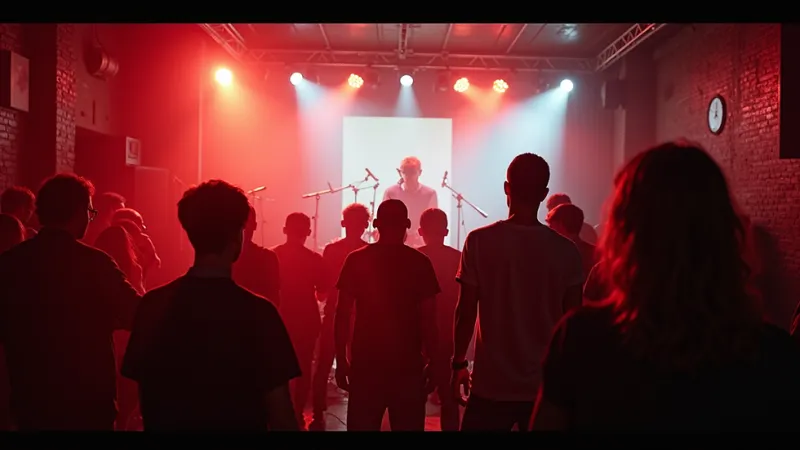
Look, nobody's saying every audience has to be a seething, stage-diving mass of bodies. Not every gig is Leeds on a Saturday night. But there is something uniquely deflating about playing three-minute blasts of controlled fury to a room of people who are primarily concerned with whether their Instagram story has uploaded correctly.
The Varukers write songs about nuclear war, state violence, the grinding machinery of a system designed to keep ordinary people exactly where they are. These are not background music topics. And yet there will always be a contingent at any given gig who treat live music as ambient wallpaper for their evening, something happening over there while they get on with the actual business of existing.
The honest response to this — and it's one the band have been known to deploy — is to simply play louder and faster until the room has no choice but to pay attention. It doesn't always work. But it's more satisfying than the alternative.
The phone thing has got worse, not better. There's a whole generation of gig-goers who experience live music primarily through a four-inch screen, documenting the event rather than actually being present for it. For a band whose entire existence is built on immediacy — on the raw, physical, in-the-room impact of punk played at full tilt — this is a particular kind of insult. Not a fatal one. But an irritating one.
Turning Setbacks Into Fuel
Here's the thing about all of these obstacles — the cursed gear, the hostile venue owners, the distracted crowds, the van breakdowns, the promoters who disappear with the door money, the soundchecks that run three hours over, the support bands who use all the backline without asking. None of it has ever actually stopped The Varukers.
And that's not because they're superhuman or because punk is somehow magic. It's because the alternative — letting any of this stuff become a reason to quit — would mean handing a victory to exactly the kind of mundane, grinding nonsense that the songs are arguing against in the first place.
The system that The Varukers have been raging at for decades works partly through spectacular oppression and partly through sheer tedious attrition. It wears you down with inconvenience. It kills things not with a dramatic confrontation but with a broken cable, a late payment, a room that's too cold and a crowd that doesn't care.
Refusing to be worn down by any of that — turning up anyway, playing hard anyway, meaning it anyway — is its own kind of political act. Not a glamorous one. Not one that makes for a tidy paragraph in a retrospective.
But it's the one that's kept this band standing while venues have closed, labels have folded, and scenes have come and gone around them.
The PA will blow again. Some landlord somewhere will pull the plug. Someone in the crowd will spend half the set photographing their own shoes. None of it matters. The Varukers will still be there, playing like the world owes them nothing and expecting nothing back.
That's not spite. That's punk.